Why We Chose It
The Bonham Conclusion
We chose Capay Hills Orchard because they did something no certification body, no regulatory exemption, and no marketing claim can replicate: they engineered the contamination problem out of their harvest process entirely. The result is a truly raw, unpasteurized almond that does not require a legal workaround — it simply never needed to be treated.
The USDA's 2007 pasteurization mandate was triggered by salmonella outbreaks at large California almond processing facilities. The root cause was straightforward: almonds harvested by sweeping nuts off the ground come into contact with soil pathogens. The industry's response was to chemically fumigate or steam-heat every almond in the country after the fact — including almonds from small family farms that never had a contamination incident. Propylene oxide (PPO), the fumigant approved for over 68% of US almonds, is classified by the EPA as a probable human carcinogen. Steam treatment degrades enzymes and oxidizes natural fats. Neither solution addresses the underlying problem. They both simply treat the symptom.
Capay Hills Orchard built a hydro-mechanical shaker with an integrated catch frame tarp system. The machine shakes the almond trees; the almonds fall onto the tarp, never touching the ground. The contamination pathway is gone. The food safety problem the mandate was designed to address does not exist on this farm. The almonds go from tree to tarp to your door — untreated, alive, and whole.
Add to this USDA Certified Organic and Real Organic Project certifications, a family of eight who live in the middle of their orchard and drink the same well water their trees do, dedicated equipment that processes nothing else, and a harvest stored on-farm in temperature and humidity controlled conditions — and you have the most thoughtfully constructed truly raw California almond operation we found. We are transparent about what we do not know: no independent heavy metals testing has been published for this product, and the packaging is plastic. We say both things clearly. The tarp harvest innovation and the depth of organic commitment are what earned the Gold Label.
Who They Are
Capay Hills Orchard — A Family of Eight, 1,400 Trees, One Right Way to Do It
Brian and Gretchen Paddock started Capay Hills Orchard in the Capay Valley of central California — a small agricultural valley between the coastal mountains and the Sacramento Valley, known for its organic farming heritage. Their family of eight — all of them — farm the property together. Their home sits in the middle of the orchard. They drink the well water on the same land where they grow their almonds.
That last detail is not incidental. It means every decision about what goes into the soil and water around this farm is also a decision about what the Paddock family drinks. There is no separation between the farming operation and the household. That is a more direct accountability than any certification can create, and it is one of the reasons we trust their organic commitment at a level beyond what the label alone would justify.
Their farming practices reflect this. They do not till the soil under their trees. They maintain a year-round ground cover of grass, clover, and dandelions — habitat for ground-nesting bees and a natural system for water retention and erosion prevention. Their neighbor beekeepers use the native vegetation alongside the orchard to breed queen bees long after the almonds have bloomed. Weed control in the tree rows is done by flaming — burning weeds with a torch — because strip-spraying with herbicides is not acceptable to them, even though it would be significantly faster and cheaper. These are not the choices of a farm that pursued an organic certification for marketing purposes. These are the choices of a family that has thought carefully about every dimension of how they farm.
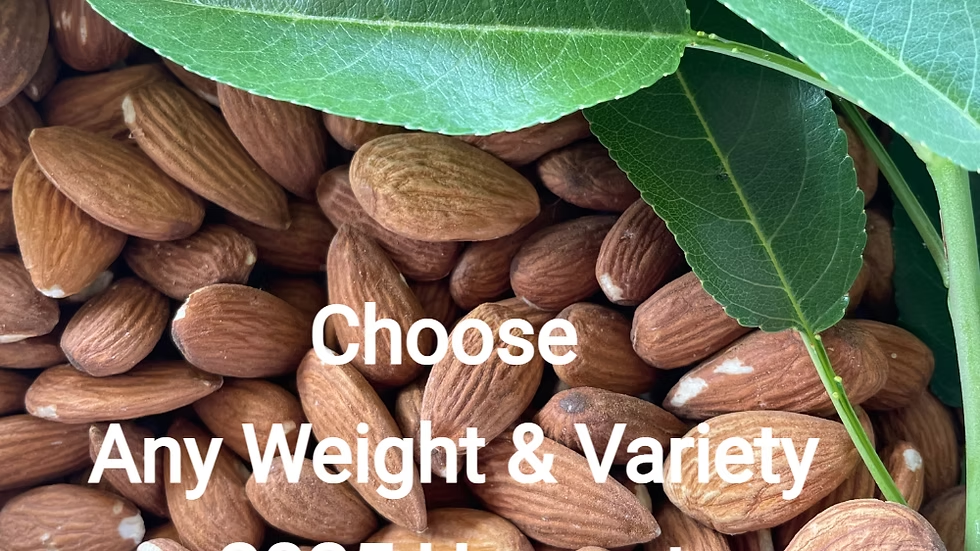
The orchard produces three California almond varieties — Nonpareil, Monterey, and Fritz — and offers blended options as well. Customers select their preferred variety at the time of order. Every bag comes from the same certified organic, tarp-harvested, family-farmed orchard in Esparto, California. They ship directly from the farm via USPS Priority Mail.
Claims & Certifications
What Makes Capay Hills Genuinely Different
Independent Research & Lab Testing
What We Know and What Remains Open
No independent third-party heavy metals testing has been published for Capay Hills Orchard almonds as of the date of this post. Lead Safe Mama, LLC has not published a heavy metals lab report for this product. No public Certificate of Analysis is available. We say this directly because our readers deserve to know which products have been confirmed clean through independent lab testing and which have earned their Gold Label designation through sourcing integrity, farming practices, and certifications. Capay Hills is firmly in the second category.
The organic certification record here — USDA Organic plus Real Organic Project — represents two independent bodies that have verified actual on-farm practices. The no-till operation, year-round ground cover, and chemical-free weed management that the Paddock family maintains are documented practices, not claims. The dedicated equipment means no cross-contamination from shared processing. And the tarp harvest system means no ground contact — the contamination pathway that makes pesticide-free status most meaningful for food safety is simply not present on this farm.
The most important food safety verification for a California almond is not a heavy metals test — it is confirmation that the almond was never exposed to propylene oxide or steam heat. Capay Hills' tarp harvest system and direct-farm sales model provide that confirmation. These almonds were never treated because the food safety case for treating them was never applicable here.
The Broader Picture
Why the Industry Chose Chemicals Instead of Tarps — And What That Choice Costs You
When the California Almond Board lobbied the USDA for a mandatory pasteurization rule in 2007, there were two ways to address the salmonella problem. The first was to change how almonds are harvested — specifically, to stop sweeping them off the ground, which is where the contamination comes from. The second was to apply a chemical or thermal treatment to every almond after the fact, regardless of how it was harvested. The industry chose the second option. The USDA agreed. The result is that over 68% of American almonds are now treated with propylene oxide gas, a probable human carcinogen, and the remaining almonds are steam-heated in a way that degrades their nutritional value. Both methods apply to every domestic commercial almond sold in the country — from the largest industrial processor to the smallest family farm that never had a contamination incident in its history.
The tarp harvest solution was available in 2007. It is not a new technology. Catching almonds on tarps rather than sweeping them off the ground is straightforwardly safer, cleaner, and more consistent with producing a high-quality nut. It costs more and requires different equipment. Industrial scale operations harvesting hundreds of acres with large mechanical sweepers were not willing to make that investment. The Almond Board's preferred solution — mandatory chemical treatment — had the added benefit, from the industry's perspective, of applying to every farm in California, including small organic farms that were already producing safe almonds without it. The mandate effectively eliminated competition from the one segment of the market that was doing it right.
Capay Hills Orchard is the demonstration that the tarp harvest approach works at farm scale. Brian and Gretchen Paddock built their system, certified their orchard organic, joined the Real Organic Project, and have been selling truly raw unpasteurized California almonds directly to American families for years. Their website is the virtual extension of their roadside stand — the legal mechanism that makes direct farm-to-consumer sales of untreated almonds possible. It takes one click to order from them directly. The almond that arrives at your door has never been touched by propylene oxide, never been steam-heated, never been swept off a dirt floor. It came off a tree, onto a tarp, into a bag, and to you. That is the almond as it was always meant to be produced.