Why We Chose It
The Bonham Conclusion
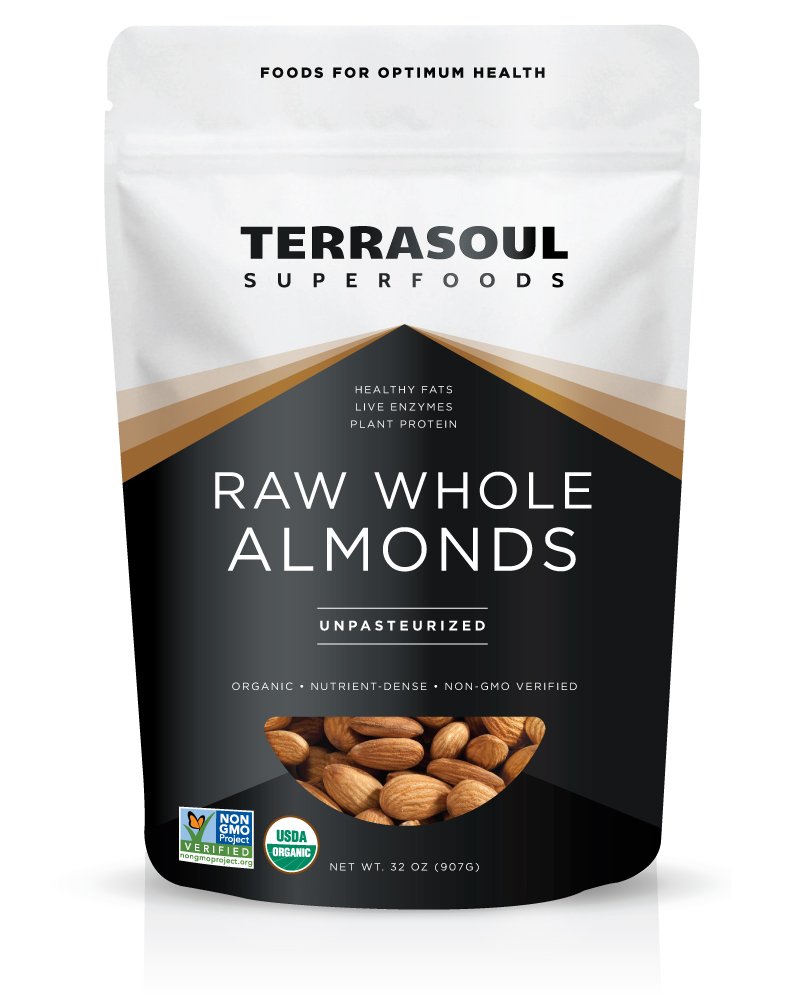
We chose Terrasoul Raw Unpasteurized Organic Almonds because they are genuinely raw — and that is rarer than it sounds. In the United States, it is virtually impossible to buy a truly raw almond from a retail shelf. The problem is not labeling fraud. It is federal law.
Since 2007, a USDA mandate has required that all commercially sold California-grown almonds be "pasteurized" before reaching consumers. California grows over 80% of the world's almonds. The pasteurization rule applies regardless of how the almond is labeled — "raw," "natural," "whole," "unsalted" — none of it matters. Every single one has been treated. The two permitted methods are steam heating, which degrades live enzymes and oxidizes heat-sensitive fats, and propylene oxide (PPO) fumigation — a chemical classified as a probable human carcinogen by the EPA, banned for use on food in most other countries, and the same compound used to manufacture antifreeze and polyurethane foam. Over 68% of US almonds are treated with PPO. Organic almonds cannot use PPO, but they are still steam-heated. Under the Bonham Gold Label standard, both methods are disqualifying. An almond that has been heated or chemically treated is not a whole food.
Terrasoul solves this by sourcing from Spain, where no such mandate exists. Their almonds are imported directly, never treated, never heated, never steamed, never fumigated. The enzymes are alive. The natural fats are intact. The almond tastes the way an almond is supposed to taste. And you can sprout them — which is the clearest possible proof that a nut is genuinely raw and has not been killed by heat or chemicals.
We are being transparent about what we do not know. No independent third-party heavy metals testing has been published for Terrasoul almonds. Their pesticide testing is internal rather than a third-party COA. The packaging is plastic, which is a meaningful negative under Gold Label standards. We say all of this clearly. Despite these open questions, Terrasoul earned the Gold Label because it clears the most important bar in this category: it is genuinely, verifiably unpasteurized — and that puts it in a different category from nearly everything else on the market.
Who They Are
Terrasoul Superfoods — Direct Import, Cold Storage, Quality Discipline
Terrasoul Superfoods is a small family-run business based in Fort Worth, Texas, built around one principle: source the freshest, most nutrient-dense foods directly from growers and get them to customers without the degradation that commercial distribution typically introduces. Unlike most grocery brands that use co-packers and third-party distributors, Terrasoul imports, tests, and packages their ingredients directly in their own USDA Organic certified facility.
For their almonds specifically, Terrasoul sources the Valencia variety from organic farms in Spain — a cultivar that is not commercially grown in the United States. Valencia almonds have a higher natural oil content and a more pronounced almond flavor than the Nonpareil and Carmel varieties that dominate California production. The difference is real and noticeable: these almonds taste richer, more complex, and more authentically of themselves.
Terrasoul refrigerates their almonds during storage and throughout shipping — a discipline that most commodity nut sellers skip entirely. Raw, truly unpasteurized almonds contain live fats that are sensitive to heat and oxidation. Ambient warehouse storage can degrade those fats before a customer ever opens the bag. Cold chain discipline preserves what makes a truly raw almond worth eating in the first place. It is a quiet detail that reflects genuine quality commitment.
The brand also conducts internal batch testing for aflatoxins and pesticide residues. We note this is internal testing rather than an independent COA — we do not treat it as equivalent to third-party verification, and we disclose the distinction. But the discipline of batch testing at all is meaningfully above what most almond sellers practice.
Claims & Certifications
What Terrasoul Claims — And What Each One Actually Means
Independent Research & Lab Testing
What Outside Organizations Found — And What Has Not Yet Been Tested
We want to be direct with you: no independent third-party heavy metals testing has been published for Terrasoul Raw Unpasteurized Almonds as of the date of this post. Lead Safe Mama, LLC — the primary independent consumer goods testing organization we rely on at Bonham Brands — has not published a heavy metals lab report for this specific product. Mamavation has not published pesticide or PFAS testing for Terrasoul almonds specifically. No public Certificate of Analysis is available from the brand for their almond product. We say this clearly because our readers deserve to know the difference between a product we trust for its sourcing model and certifications, and one that has been independently confirmed clean at the contaminant level through third-party lab testing.
What we can say is this: almonds are not a high-risk heavy metals category the way rice, oats, cassava, and root vegetables are. The contamination pathways that concentrate cadmium, arsenic, and lead in those crops — particularly soil absorption in high-water-demand cultivation — are less pronounced in tree nuts grown in well-drained Mediterranean soils. This does not mean almonds are free of heavy metal risk, and we will not claim it does. It means the baseline risk profile is meaningfully lower, and that the absence of published testing is a gap we are disclosing — not evidence of a confirmed problem.
Terrasoul's internal batch testing for aflatoxins is worth noting here. Aflatoxins are a genuine concern for almonds — they are produced by Aspergillus mold species that can colonize damaged or improperly stored nuts. The fact that Terrasoul tests for aflatoxins on every batch, combined with their cold storage and shipping discipline, is a meaningful quality practice. We note again that this is internal testing, and we will update this page if and when independent aflatoxin or heavy metals testing is published for this specific product.
The most important independent verification for almonds sold in the United States is not a heavy metals test — it is confirmation that the almond is genuinely unpasteurized. Terrasoul's Spanish origin and explicit unpasteurized claim, combined with their sproutable almonds, provides that confirmation in a way no USDA label or third-party certification can offer for a domestically sourced product.
The Broader Picture
Why the Almond Industry Has a Transparency Problem — And What It Costs You
The 2007 USDA pasteurization mandate was one of the most consequential and least-discussed regulatory decisions in modern food history. It was enacted in response to two salmonella outbreaks — 33 people became ill across both incidents, none died — that were traced to large industrial almond processing plants. The California Almond Board lobbied for a mandatory treatment rule across the entire industry. The USDA agreed. And overnight, every almond sold commercially in the United States became legally required to be treated.
The mandate has no labeling requirement. There is no obligation to disclose the treatment method — steam, PPO, or otherwise. A bag of almonds labeled "raw" can legally contain almonds that were fumigated with propylene oxide gas, a compound the EPA classifies as a probable human carcinogen and that lost its food additive regulatory status decades ago. Consumers buying almonds for their nutritional properties — the live enzymes, the intact vitamin E, the natural fats — are paying for those properties and receiving a product from which they have largely been removed by law. The industry knows this. The label does not say so.
The irony is that the food safety problem the mandate was designed to solve — salmonella contamination — was caused by the way California almonds are harvested: knocked from trees and swept off the ground, where they come into contact with soil pathogens. Farms that harvest onto tarps, as several small California farms now do, eliminate that contamination pathway entirely without any chemical or thermal treatment. But the mandate applies uniformly regardless of harvesting method, and it covers only domestically grown almonds — which is why imported European almonds represent the only clean path to a truly raw product for most American consumers.
At Bonham Brands, we believe families deserve to know what is actually in the food they are eating — and what has been done to it before it reaches them. The almond is a genuinely excellent food: high in vitamin E, magnesium, healthy monounsaturated fats, and fiber. But those qualities are diminished by heat treatment and eliminated by chemical fumigation. The almonds on our Gold Label list earn that designation because they deliver what the label says. They are raw. They have not been treated. The enzymes are alive, the fats are intact, and the food is whole. That is what we are looking for, and it is rarer than it should be.