Why We Chose It
The Bonham Conclusion
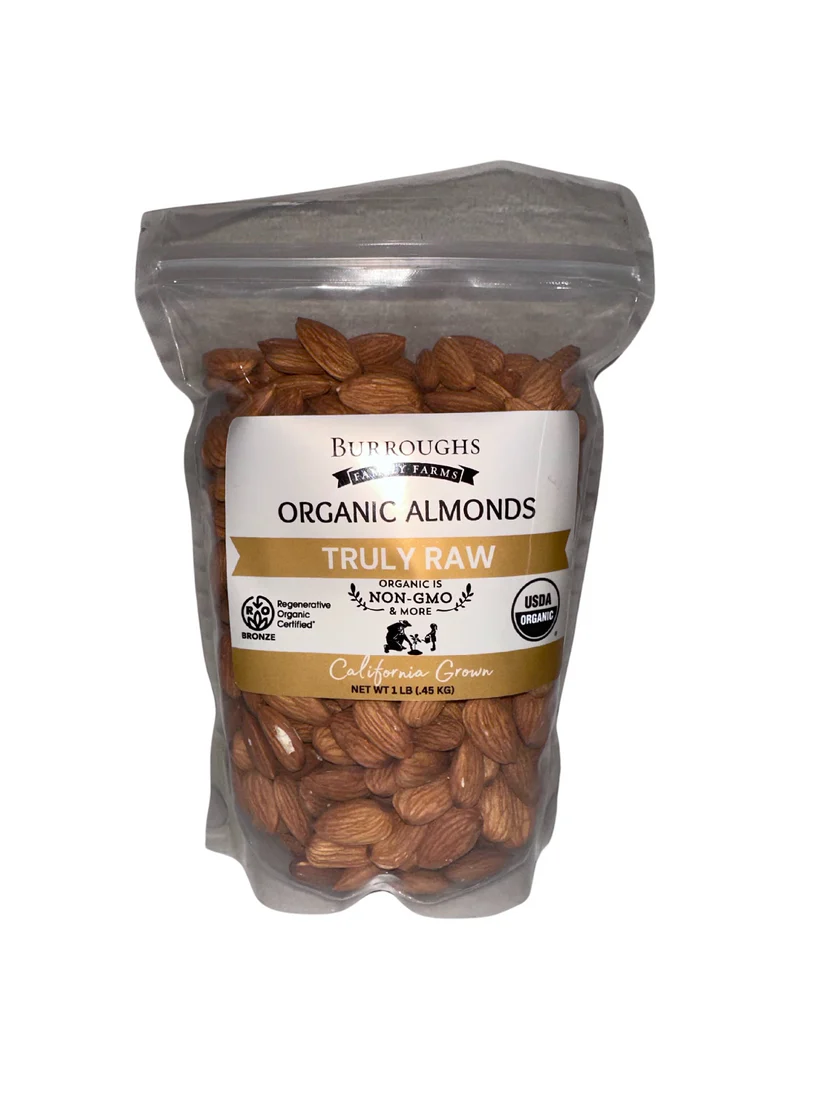
We chose Burroughs Family Farms Truly Raw Organic Almonds because this farm has done something no other almond farm in the world has done: earned the full combination of USDA Organic, Regenerative Organic Certified, and Regenified certification — while selling truly unpasteurized almonds directly to families who want to know exactly what they are eating and exactly how it was grown.
The "Truly Raw" on their label is not marketing language. In the United States, virtually every almond sold commercially has been treated since 2007 — either with steam heating, which degrades live enzymes and oxidizes natural fats, or with propylene oxide (PPO) gas, a chemical the EPA classifies as a probable human carcinogen. It is the same compound used to make antifreeze and polyurethane foam. Over 68% of US almonds are treated with PPO. Organic almonds cannot use PPO — but they are still steam-heated. There is no labeling requirement. The bags say "raw." The industry says nothing.
Burroughs Family Farms operates under the USDA's small farm roadside stand exemption — one of the only legal pathways for a California farm to sell almonds that have never been treated in any way. Their almonds are not pasteurized. They are not steam-heated. They are not fumigated. The enzymes are alive. The natural fats are intact. The nut is whole. And when they write "TRULY RAW" on the bag in gold letters, they mean it in every legal and biological sense of the word.
On what we do not know: no independent third-party heavy metals testing has been published for this product. We disclose this clearly. It is a gap in the verification record, not a confirmed problem — almonds are not a high-risk heavy metals category. But we have not seen the lab data, and we say so. What we have seen is a farm with a 130-year history, the world's most rigorous regenerative farming certifications, and a commitment to transparency that is rare in any food category, let alone in a category as opaque as the American almond industry.
Who They Are
Burroughs Family Farms — Five Generations, One Hundred and Thirty Years, One Farm
Benjamin Burroughs came to California from Illinois in 1894. What he started became a small dairy in 1906, then grew across five generations into the farm that Benina Montes — Ward and Rose Marie Burroughs' daughter — runs today with her husband Heriberto in the northern San Joaquin Valley, not far from Yosemite National Park. This is not a corporation that acquired farmland and applied for certifications. This is a family that has been farming the same land for 130 years and has chosen, generation by generation, to do it with increasing integrity.
Benina started transitioning their almond blocks to organic in 2006. By 2015, the entire farm was certified organic. She then pursued Regenerative Organic Certification — a standard that goes well beyond USDA Organic — and in June 2022, Burroughs Family Farms became the world's first Regenerative Organic Certified almond farm. In 2024, they added Regenified Certification, a second independent regenerative credential that further confirms their farming practices meet the most demanding available standard for soil health, water management, biodiversity, and farmworker wellbeing.
They also grow walnuts, raise pastured poultry, and produce olive oil on the same land. It is a diversified, integrated family farm operation — the kind of farming that builds soil health rather than depleting it, that works with the land's natural systems rather than against them. Their almonds are never co-mingled with almonds from any other farm. When you order from Burroughs, you know whose land your almonds came from, whose hands packaged them, and what that family has stood for across five generations.
Claims & Certifications
What Burroughs Claims — And What Each Certification Actually Means
Independent Research & Lab Testing
What Outside Organizations Found — And What Remains Open
No independent third-party heavy metals testing has been published for Burroughs Family Farms almonds as of the date of this post. Lead Safe Mama, LLC has not published a heavy metals lab report for this product. No public Certificate of Analysis is available from the brand. We say this clearly because our evaluation framework requires us to distinguish between products that have been independently confirmed clean at the contaminant level and products that have earned their designation on the strength of farming standards and transparency. Burroughs is firmly in the second category — and we mean that as a compliment to how rigorous their farming standards are, not as a hedge.
The organic certification record on this farm is 18 years deep. USDA Organic certification requires annual on-site inspections and documentation of all inputs — 18 consecutive years of certified compliance is a meaningful track record. ROC certification adds independent auditing of soil health outcomes and ecosystem management. Regenified adds a third independent assessment. The probability that a farm with this level of multi-body certification oversight is using prohibited inputs is effectively zero. The gap in our evaluation is independent product-level testing for heavy metals — which is a soil and environmental contamination question, not a farming inputs question. We will update when that data is available.
The most important thing an independent organization can verify about a California almond is whether it has been pasteurized. Burroughs Family Farms answers that question definitively — on the label, on their website, in their explanation of the USDA exemption that makes it possible. "Truly Raw" is not a label claim here. It is a verifiable fact.
The Broader Picture
What the California Almond Industry Chose — And What One Family Farm Refused to Accept
The 2007 USDA pasteurization mandate did not happen by accident. It happened because the California Almond Board — the trade body representing large industrial almond processors — lobbied for a mandatory treatment rule following two salmonella outbreaks. Thirty-three people became ill across both incidents. None died. The outbreaks were traced to large almond processing facilities where almonds harvested off the ground were pooled in bulk with almonds from hundreds of other growers before being washed, sorted, and distributed. The contamination risk was a function of industrial scale and ground-harvesting practices. The solution was not to change those practices. It was to apply a chemical or thermal treatment to every almond in the country, from the largest processor to the smallest family farm.
Propylene oxide — the fumigant approved for over 68% of US almonds — is a chemical the EPA classifies as a probable human carcinogen. It lost its food additive regulatory status from the EPA decades ago on the grounds that it "induces cancer in animals." It is banned for use on food in most other countries. The Almond Board lobbied to have it approved as a pasteurization method anyway, under a different regulatory classification. The USDA agreed. The result is that American families buying almonds from a grocery store — including bags labeled "raw," "natural," or "organic" — are receiving almonds that have been either steam-heated or gassed with a probable carcinogen. The label is not required to say so.
What Burroughs Family Farms represents is the alternative that was always available and consistently ignored. Small farms that harvest almonds onto tarps — rather than sweeping them off the ground — eliminate the contamination pathway that triggered the mandate in the first place. Almonds harvested cleanly from the tree, on a small organic farm with direct-to-consumer distribution, do not need to be fumigated or steam-treated. They never did. The USDA's small farm exemption acknowledges this implicitly, which is why it exists. But it took a family like the Burroughs — four generations deep in California soil, committed to organic and regenerative practices before either certification existed in its current form — to actually use it and make truly raw California almonds available to the public.
This is what Bonham Brands is looking for. Not the easiest product to recommend. Not the most widely distributed. Not the one with the most affiliate revenue potential. The best one — the one that does the thing right, all the way down. Burroughs Family Farms is that for almonds grown in California, and we are proud to have them on the Gold Label list.