Why We Chose It
The Bonham Conclusion
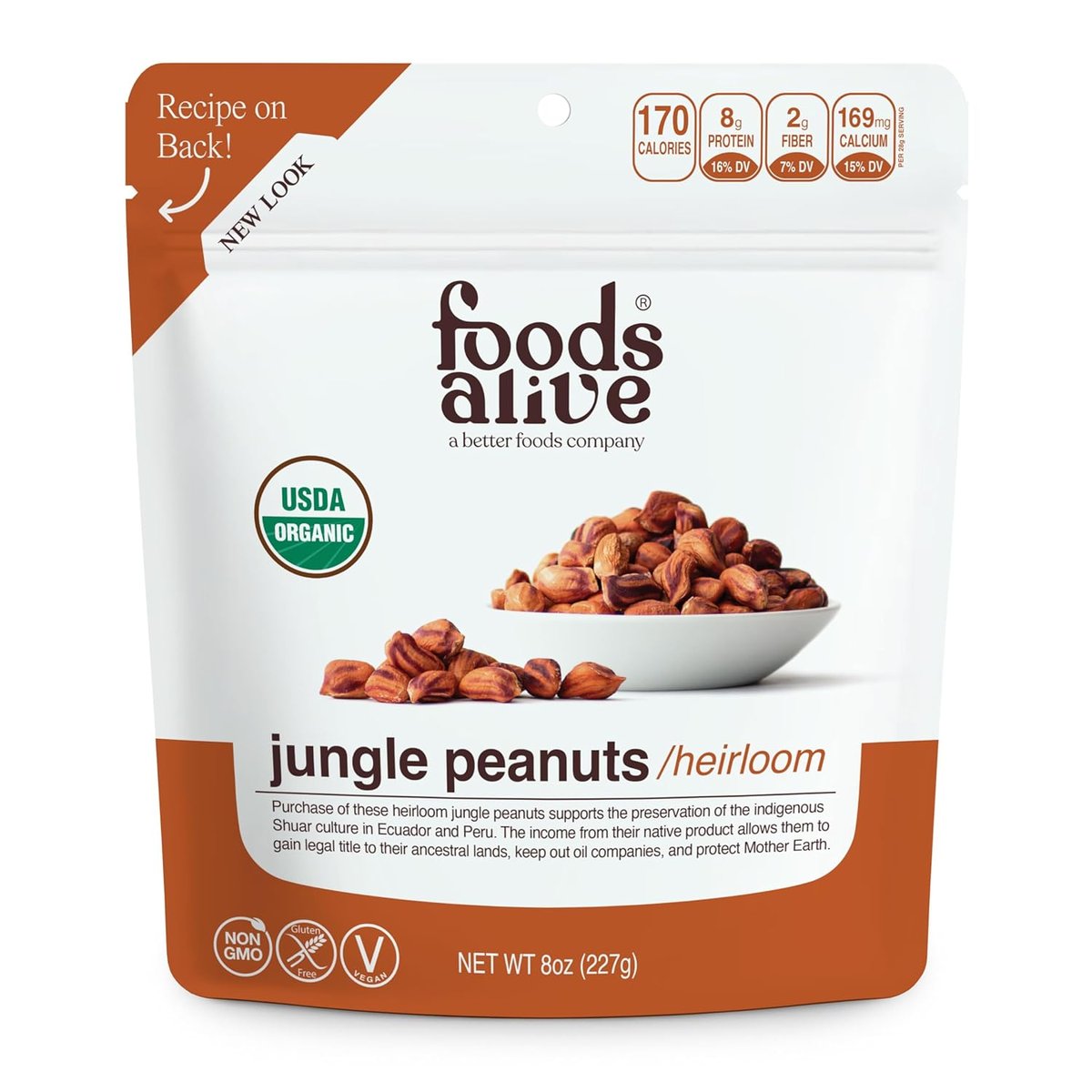
We chose Foods Alive Organic Jungle Peanuts because they are the most natural peanut we could find — and "natural" here is meant literally. There is one ingredient in the bag: certified organic, unroasted jungle peanuts. No oil, no salt, no preservatives, no processing aids. They are genuinely raw, certified USDA Organic through ECOCERT, and they carry a sourcing story almost nothing else in the category can match.
Jungle peanuts are an heirloom variety — long, lean, marked with a deep chocolate-colored stripe — widely believed to be among the ancestral peanuts that today's commercial varieties descend from. They are wild-harvested by the indigenous Shuar people in the Amazon rainforest near the Ecuador–Peru border and flown out on small planes. Buying them supports the Shuar's effort, coordinated with Amazon Watch, to hold legal title to their ancestral land and keep oil development out. As food, they are a complete protein with all the essential amino acids including methionine, plus oleic acid, vitamin E, magnesium, calcium, and iron — and they taste richer and more aromatic than a commodity peanut.
We are being transparent about what we do not know. Foods Alive markets these peanuts as "aflatoxin-free," and we do not repeat that as verified fact — it is the producer's own claim, there is no independent laboratory Certificate of Analysis behind it, and the humid rainforest is the opposite of the dry climate associated with naturally low aflatoxin. Like all peanuts, these are a ground crop that takes up trace cadmium from soil, and the bag carries a California Proposition 65 lead notice. No independent contaminant testing has been published for this specific product. We say all of this plainly, in full, below.
Despite those open questions, these peanuts earned the Bonham Gold Label because the strengths are real and verifiable — genuinely raw, real organic certification, the cleanest possible ingredient list, and an exceptional, transparent supply chain — and the gaps are honestly disclosable. For perspective: these are among the best peanuts an American shopper can actually buy. Genuinely cleaner peanuts exist abroad — Australia's certified-organic, low-cadmium crop chief among them — but they do not distribute to the United States.
Who They Are
Foods Alive — A Family Company and an Amazon Sourcing Story
Foods Alive is a family-run company that has been making minimally processed whole foods since 1999, based in Angola, Indiana. Their model is built around keeping foods close to their natural state — raw, unrefined, single-ingredient wherever possible — rather than processing them for shelf appeal. It is a small-company ethos, and it shows in a product like this one.
For the jungle peanut specifically, the sourcing is the story. These are not farmed commodity peanuts. They are an heirloom variety wild-harvested by the indigenous Shuar people deep in the Amazon rainforest near the Ecuador–Peru border, then flown out on small aircraft because there is no road infrastructure for commercial transport. It is a genuinely different supply chain from anything in the conventional peanut aisle.
The purchase carries a purpose beyond the peanut. The Shuar — a community of several thousand with title to a large area of primary rainforest — have organized against oil exploration on their ancestral land. Foods Alive's sourcing, coordinated with Amazon Watch, channels demand toward that effort, giving the standing forest an economic value that does not require cutting or drilling it.
The product itself reflects the same restraint: genuinely raw and unroasted, certified organic, a single ingredient with nothing added. It is the kind of food that needs very little explanation once you understand what is — and isn't — in it.
Claims & Certifications
What Foods Alive Claims — And What Each One Actually Means
Independent Research & Lab Testing
What Has, and Hasn't, Been Independently Tested
We will be direct: no independent third-party laboratory has published a Certificate of Analysis for this product's aflatoxin or heavy-metal levels as of the date of this post. Lead Safe Mama, LLC — the primary independent testing organization we rely on at Bonham Brands — has not tested jungle peanuts. There is no public Certificate of Analysis from the brand for contaminant levels. We say this clearly, because readers deserve to know the difference between a product we trust for its sourcing and certifications and one that has been independently confirmed clean at the contaminant level through third-party testing.
Here is the part that applies to every peanut, not just this one. Peanuts grow underground, and their roots take up trace heavy metals — especially cadmium, and to a lesser degree lead — from soil. This is structural to the crop, not a defect of any brand. Independent testing by Lead Safe Mama has found measurable cadmium in every peanut and peanut-butter product tested. That is why this bag, like a great many whole foods, carries a California Proposition 65 notice naming lead.
Foods Alive addresses that Proposition 65 notice openly: they explain it simply informs customers that any amount of lead or cadmium might be present, that they are required to post it because they sell in California, and that it does not mean the product is dangerous — adding that for most of their products the levels are so low they cannot be measured by equipment built to detect dangerous levels. What remains unknown is the specific measured level for this product, because no independent Certificate of Analysis exists, and we will not guess at numbers. The wild rainforest origin's effect on metal uptake is likewise undocumented: no evidence it is lower, no reason to assume it is higher, than other peanuts.
The honest bottom line applies to every peanut we list: assume all peanuts carry some cadmium, because they are a ground crop and the testing that exists supports that. The only documented tested-low exception is Australia's Greenacres, grown under a national low-cadmium program — and it is not sold to US consumers. We would rather tell you this plainly than let an organic label imply a purity that no peanut can currently prove.
The Broader Picture
Aflatoxin, Heavy Metals, and Why Peanut Origin Matters
Two facts shape the purity of any raw peanut, and neither is a given brand's fault. The first is aflatoxin. The mold that produces it thrives in warm, humid conditions, so peanuts from dry or temperate regions tend to be lower-risk and those from hot, humid origins tend to be higher. Roasting reduces aflatoxin substantially — which is precisely why a raw peanut leans so heavily on its variety, climate, and handling. And a point worth repeating because it is so often misunderstood: organic certification does not lower aflatoxin. Organic peanuts can carry just as much as conventional ones, sometimes more, because certification governs how a crop is grown, not the mold that may grow on it after harvest.
The second is heavy metals — chiefly cadmium. Because peanuts are a ground crop, cadmium uptake is a whole-category reality rather than a brand problem, and most of the peanut industry simply does not publish testing for it. That silence is the norm, not the exception. We think the honest response is neither to pretend the issue away nor to fear-monger about it, but to disclose it plainly and let you weigh it for yourself — which is why this product carries its own full heavy-metals disclosure on its page.
So why choose these peanuts at all? Because on the things that can be controlled and verified — genuinely raw, certified organic, single-ingredient, an exceptional and transparent supply chain — Foods Alive sits at the front of what an American shopper can actually buy. The genuinely cleanest peanuts in the world do exist, but they are grown in Australia under a national low-cadmium program and do not distribute to the United States. Within what is reachable here, this is among the very best, and it is honestly disclosed.
At Bonham Brands, we believe families deserve to know what is actually in the food they eat — what is proven, what is only claimed, and what is simply unknown. The jungle peanut is an exceptional food: a complete protein, rich in healthy fats and minerals, grown wild and clean of synthetic inputs. We list it with its strengths stated plainly and its open questions disclosed in full. That balance is what the Gold Label is meant to mean.