Why We Chose It
The Bonham Conclusion
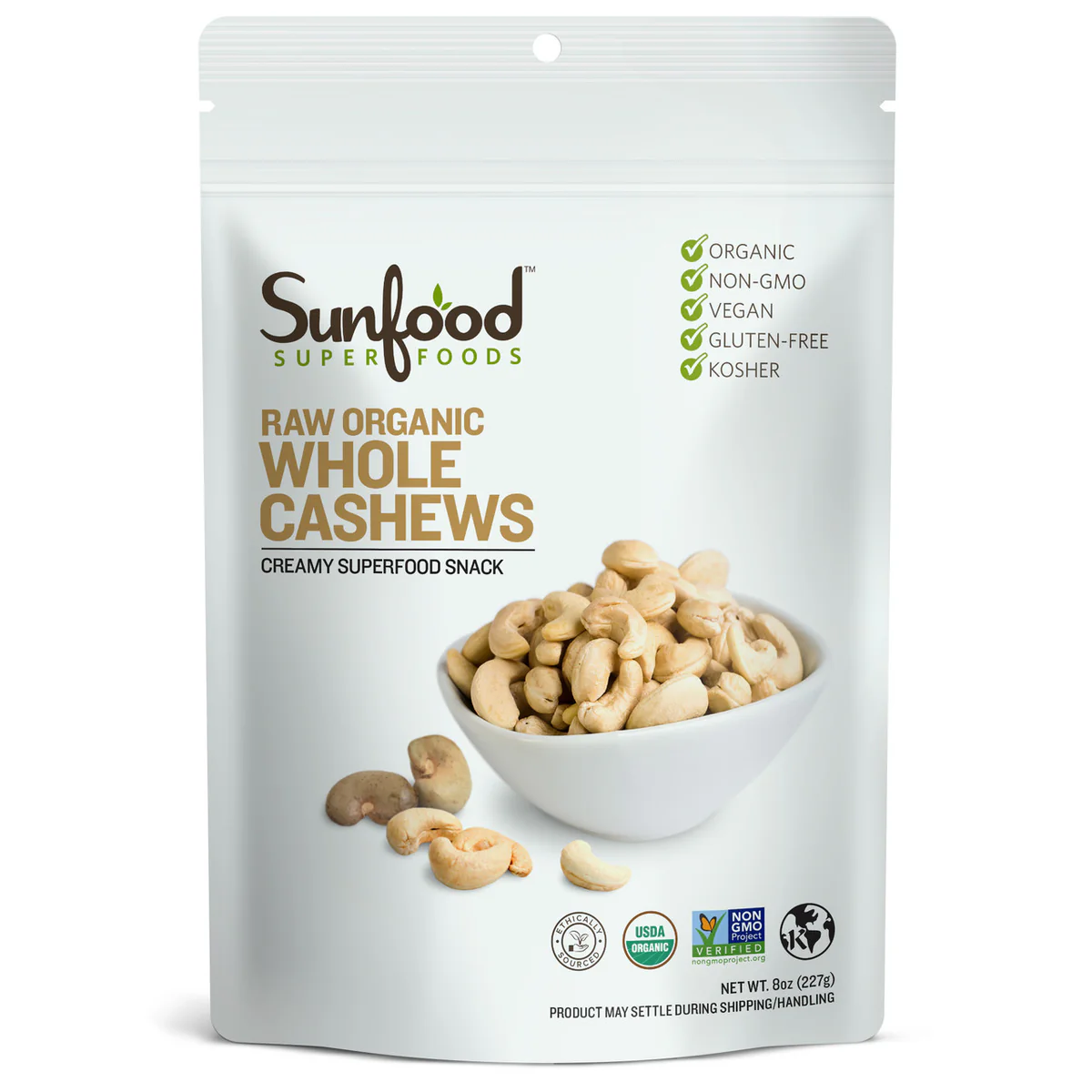
Sunfood Organic Whole Cashews are the only genuinely raw cashew a US shopper can reliably buy — from a company willing to state plainly that they are never steamed. That matters because a cashew grows inside a shell lined with urushiol, the same caustic resin found in poison ivy. The usual way to open that shell is to steam-boil or roast the whole nut at high heat, and that heat reaches the kernel. So the "raw" cashews on most shelves were, in fact, cooked once just to get them out of the shell.
Sunfood's are hand-cracked and never steamed or roasted, then dried gently below a raw threshold. One ingredient: certified organic raw cashews — USDA Organic through CCOF, Non-GMO Project Verified, and Kosher, sourced from small organic farms in Indonesia. We are equally clear about the gaps: there is no independent heavy-metals lab report, the never-steamed claim is the producer's own, and a truly raw nut has no heat kill-step. We chose it because the strengths are real and the gaps are honestly disclosable — which is exactly what a Gold Label is meant to mean.
Who They Are
Sunfood — And the Cold Method That Sets Them Apart
Sunfood Superfoods builds its catalog around keeping food close to its raw state. For cashews, that hinges on cold hand-cracking — a method refined on the Indonesian island of Flores, where workers split each shell mechanically by hand rather than softening it with steam or roasting. It is slow and low-yield, which is exactly why almost no large producer does it; steaming and roasting whole nuts by the ton is far cheaper, and it fills nearly every other bag on the shelf.
One honest caveat: "cold-processed" is not zero heat. After cracking, the kernel is still dried gently at low, raw-range temperatures. What it genuinely means is that the shell is opened mechanically rather than cooked open, and the kernel never crosses the raw threshold. Sunfood does not publish a batch-level lab report and holds no fair-trade label — gaps we score honestly — but the cold process and the certifications behind it are real.
Claims & Certifications
What Sunfood Claims — And What Each One Means
The Honest Picture
The Research, the Gaps, and the Ethics
The research: A peer-reviewed study in the Journal of Agricultural and Food Chemistry compared the cold "Flores" hand-cracking method against oil-bath roasting, steam roasting, drying, and open-pan roasting. Every conventional method significantly reduced the cashew's bioactive compounds, while hand-cracking preserved carotenoids (including beta-carotene), thiamin, and unsaturated fatty acids at levels comparable to the raw kernel. It is published at PubMed — Trox et al., 2010. The study validates the cold method as a category, not Sunfood's specific batch.
The gaps: No independent lab has published a heavy-metals Certificate of Analysis for cashews, and we will not invent numbers — though cashews are not a flagged metal accumulator the way ground crops like peanuts and rice are, so this is a data gap rather than a known risk. And because the nut is genuinely raw, there is no heat kill-step; Salmonella is a known low-but-real risk in raw tree nuts, mostly tied to fermented cashew products rather than dry whole nuts. Anyone wanting extra assurance can lightly dry-toast them at home.
The ethics: The cashew industry's documented forced- and child-labor abuses are concentrated in Vietnam and India. Sunfood's Indonesian, small-farm origin sits outside that hub — a genuine point in its favor, though the product carries no fair-trade labor certification, which we note plainly.
"Almost every 'raw' cashew was steamed or roasted to get it out of its caustic shell. A genuinely raw, hand-cracked, never-steamed cashew is the rare exception — not the rule."
Source: Trox et al., 2010. Every gap in the verification record is disclosed on the full product evaluation. We report published research honestly; we are not a laboratory and do not conduct our own testing.