Why We Chose It
The Bonham Conclusion
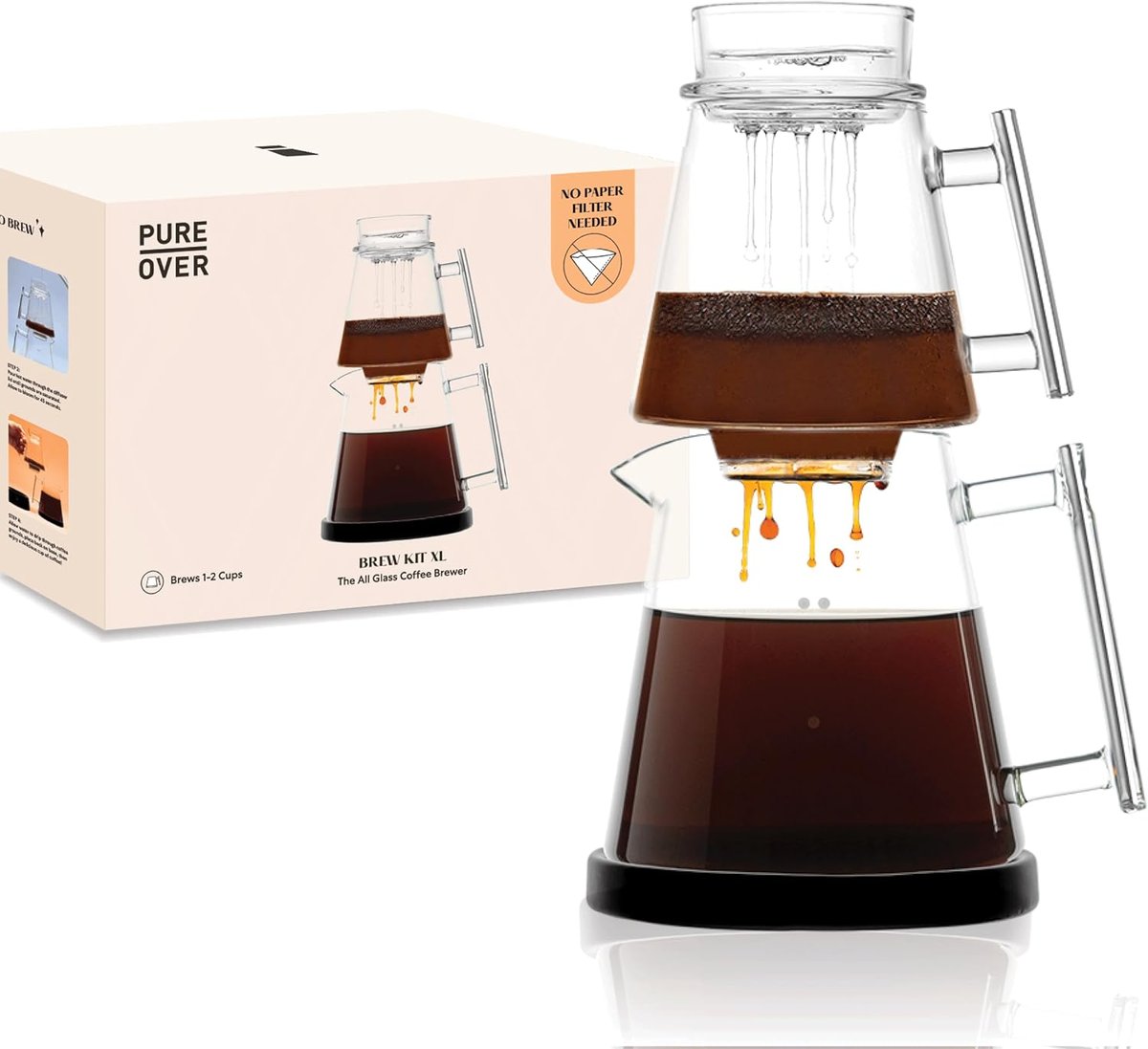
The Pure Over Signature Brew Kit is the first non-food product to earn the Bonham Gold Label, and it earned it for the same reason our food picks do: it removes what should never have been in your cup to begin with. Almost every coffee maker brews through plastic — a plastic water tank, plastic tubes, a plastic brew head — and that plastic sits in direct contact with water at roughly 200°F, every single morning. The Pure Over is built entirely from borosilicate glass and ceramic. There is no plastic anywhere in the brew path. For a household trying to lower its daily contaminant load, that one fact is the whole argument.
We are just as clear about what this is and is not. It is not a certified-organic anything — it is a brewing vessel, and the only honest question for a vessel is what it is made of and what it can release into your cup. On that question it is about as clean as a coffee maker gets: inert glass and fired ceramic, a built-in glass filter so there is no paper to bleach or buy, and nothing to rebuy or throw away. The honest trade-offs are practical rather than chemical — it is a manual pour-over that makes a few cups at a time, and it is glass, so it can break. We chose it because the strengths are real and the trade-offs are honest, which is exactly what Gold Label is meant to mean.
Who They Are
Pure Over — A Coffee Maker Born in a Glass Shop
Pure Over began with a glass artist and engineer in Portland, Oregon, named Etai Rahmil. As he tells it, he ran out of paper filters one day in the glass shop and started wondering whether he could brew coffee using only the material he worked with every day. The result was a pour-over made entirely of glass, with the filter blown right into the dripper — no paper, no plastic, no metal mesh. Every kit is still handmade by glass artisans using mold-assisted techniques, which is why each piece is consistent enough to brew well but shaped by hand rather than stamped out of a machine.
That origin matters because it explains the whole design. This is not a conventional appliance with the plastic swapped out as a marketing afterthought; it was conceived from the material up to be glass. The six-piece kit is a glass dripper with the built-in filter, a glass diffuser lid, a glass stir stick, a glass carafe, and a ceramic base and coaster. Apart from the fired ceramic — itself inert and food-safe — it is glass from the moment water enters to the moment coffee reaches your cup.
Claims & Certifications
What Pure Over Claims — And What Each One Means
Independent Research & Lab Testing
What the Research Says About Hot Water and Plastic
The research on hot water and plastic: Heat is the single biggest driver of how much plastic sheds into what it touches — and coffee is brewed hot. A widely cited peer-reviewed study found that disposable paper cups, which are lined with a thin plastic film, released large quantities of microplastic particles and other substances into hot water within minutes of contact. It is published in the Journal of Hazardous Materials by Ranjan and colleagues, available at the Journal of Hazardous Materials (Ranjan et al., 2021). The lesson generalizes: the more plastic your hot water touches on its way to the cup, the more it can carry with it. An all-glass brew path removes that contact entirely.
What we can and cannot verify for this product: We have not located an independent laboratory Certificate of Analysis specific to Pure Over's glass — and we will not imply one exists. What we can say rests on the well-documented chemistry of the materials: borosilicate glass and fired ceramic are inert and do not leach into food or water under normal use, which is precisely why they are the standard for laboratory and food-safe glassware. We present this as material-level evidence, not a product-specific lab report, and we would update this page if independent testing of the finished product becomes available.
The honest trade-offs: None of these are contaminant concerns; they are practical. It is a manual pour-over that brews one to three cups at a time and takes about four to five minutes plus a little technique. It is glass, so it can break if dropped — the one-year warranty and 30-day returns cover defects and the trial period. And a little fine sediment passes through, as in a French press.
"The purest cup isn't about what you add to your coffee. It's about what never touches it on the way to your cup."
Source: Ranjan et al., Journal of Hazardous Materials, 2021. Our full evaluation, including the honest trade-offs, is on the product page. We report published research honestly; we are not a laboratory and do not conduct our own testing.
The Broader Picture
Why Coffee Has a Plastic Problem — And Why Glass Fixes It
Coffee is one of the most plastic-mediated things many people consume daily, and almost no one thinks about it. The convenience formats that dominate the market — pod machines, plastic-bodied drip makers, plastic-lined disposable cups — all share the same flaw: they put plastic in contact with hot water at the exact moment plastic is most likely to shed. Multiply that by two cups a day over years, and a brewing method becomes a quiet, daily exposure most households never chose on purpose. It is the same pattern we see across the food world, where the contamination rarely comes from the food itself but from everything it touches on the way to the table.
Glass is the oldest answer to that problem and still the cleanest. It is inert, it is endlessly reusable, and it adds nothing to what it holds. The Pure Over takes that principle and applies it to the one appliance most kitchens run every single morning, replacing the plastic and the paper at once. It will not be for everyone — a manual pour-over asks for a few minutes and a steady hand that an automatic machine does not. But for anyone willing to make that trade, it turns the most routine cup of the day into the purest one, and that is exactly the kind of swap the Bonham Gold Label exists to point you toward.