Why We Chose It
The Bonham Conclusion
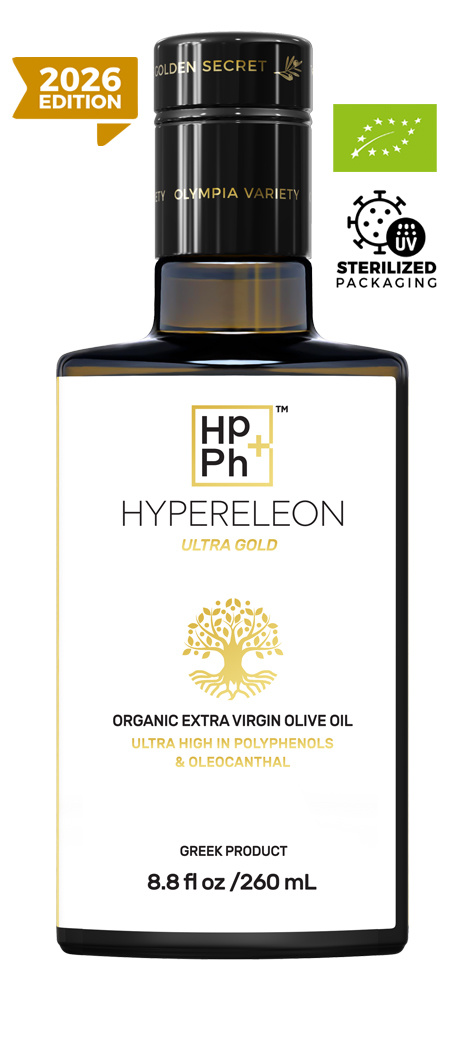
We chose HYPERELEON's Ultra Gold because it does something few oils manage: it pairs an extraordinary polyphenol count — 2,000+ mg/kg by HPLC — with genuine organic certification. Potency and purity usually pull against each other; here they don't.
The oil is made from unripe olives handpicked at the early-harvest peak of polyphenol content, then cold-pressed the same day (within about six hours) with no heat or water, and left unfiltered.
We disclose the gaps plainly: HYPERELEON doesn't publish a free-acidity figure for this bottling or an independent heavy-metal panel. It earns its Gold Label on verified potency plus a deep organic and academic certification stack, not on contaminant testing.
Who They Are
HYPERELEON — What Makes Them Different
HYPERELEON is a Greek producer built specifically around high-phenolic olive oil, drawing mainly on the Olympia olive variety. Its defining practice is harvesting olives while still green and unripe — the stage at which the fruit's protective polyphenols are at their maximum, even though it means a lower oil yield.
The olives are handpicked and cold-pressed the same day at a certified mill, using methods that avoid heat and added water so the delicate phenolic compounds survive extraction. The oil is bottled unfiltered in glass.
What sets HYPERELEON apart from most high-phenolic brands is the breadth of independent eyes on it: its phenolic content and health claim are verified by the University of Athens and the World Olive Center for Health, its food safety by TÜV Hellas, and its farming by organic certifiers in both Greece and the United States.
Claims & Certifications
What HYPERELEON Claims — And What Each One Means
Independent Research & Lab Testing
What Outside Verifiers Found — And What Isn't Tested
University of Athens & World Olive Center — phenolic verification: HYPERELEON's Ultra Gold is verified at 2,000+ mg/kg of polyphenols (HPLC), placing it among the highest organic-certified oils in the world. The producer documents its certifications and awards at hypereleon.com.
What has not been tested: HYPERELEON has not been independently tested by Lead Safe Mama or Mamavation, and no public heavy-metal, pesticide, or phthalate panel exists for this oil. Its organic certification governs pesticide inputs at the farm, but is not a substitute for a contaminant COA — so we score Heavy Metals "Not tested".
We review published lab results and independent investigator findings. We are not a laboratory and do not conduct our own testing. All primary sources are linked above for your own review.
The Broader Picture
Why Early Harvest Is the Whole Game in High-Phenolic Oil
Polyphenols peak before the olive ripens. As an olive matures from green to black, its oil yield rises but its polyphenol content falls. Producers chasing volume wait for ripeness; producers chasing health compounds pick early, accepting a much smaller yield for a far more protective oil. That single choice is the difference between a 100 mg/kg supermarket oil and a 2,000 mg/kg one.
Speed to the mill is the other half. Once picked, olives begin to oxidize and ferment. Pressing the same day, cold, without water is what preserves both the polyphenols and a low acidity. HYPERELEON's roughly six-hour window is at the demanding end of that discipline.
The bitterness is the point. A high-phenolic oil is meant to sting the throat and taste peppery and bitter — that sensation is literally the oleocanthal and oleacein. An oil that tastes bland has little of what makes olive oil worth eating for health.
As an olive ripens, its oil yield rises but its polyphenols fall. HYPERELEON picks unripe and presses the same day — trading yield for 2,000+ mg/kg of the compounds that make olive oil worth eating, without giving up organic certification.