Why We Chose It
The Bonham Conclusion
We did not go looking for a perfect product. Our standard is rigorous by design — and as anyone who follows our catalog knows, we score honestly, disclose gaps, and never inflate a rating to make a product look better than the evidence supports. We have given products low scores on heavy metals, disclosed trace detections, and flagged missing test data on items we still recommend because the overall profile is the best available. A perfect score across every dimension is rare because perfect products are rare.
Holistic Roasters Biodynamic Coffee earned a perfect score. Every single dimension. Not because we stretched the criteria to fit the product — but because the product genuinely meets every criterion we have, and then goes further than any brand we have encountered in any category. Demeter Biodynamic certification — the strictest organic standard on earth. USDA Organic certified by Ecocert. Two independent accredited laboratories testing every single harvest. All certificates of analysis published unedited on their website, organized by harvest date, with the lab names and accreditation numbers listed. Including, importantly, the one result that most brands would have quietly suppressed.
That last detail matters more than almost anything else in this evaluation. In December 2025, testing identified a trace amount of a non-regulated compound — Mycophenolic Acid at 0.05 ppm — in one harvest lot. It is not regulated by the FDA or the EU. At five cups of coffee per day, a person would consume approximately 3.5 micrograms — roughly one-millionth of the lowest medical therapeutic dose. Holistic Roasters published the full certificate of analysis anyway, unedited, with the result visible on the very same page as their other clean results. They did not remove it, minimize it, or explain it away. They published it because it happened, and because their customers deserve to see every result they receive. That is the standard this brand holds itself to.
There are also no transparency flags on this product. No gaps to disclose. No testing categories without data. No certifications we wish they had pursued. Every contaminant we look for has been tested, documented, and published. The packaging is 100% compostable — including the degassing valve and resealable zipper, which are the most common sources of microplastic leaching in coffee packaging. This is as clean as coffee gets, demonstrated and proven at every level from the soil it was grown in to the bag it arrived in.
Who They Are
Holistic Roasters — Built Around One Uncompromising Idea
Holistic Roasters is a specialty coffee company based in Montreal, Canada, built around a simple and uncompromising premise: that the healthiest coffee should also be the most transparent coffee, and that the only way to prove cleanliness is to test for it, document it, and publish everything you find. They source exclusively from single-estate regenerative farms — meaning every bag they sell is traceable to a specific farm, not a regional blend or anonymous supply chain. Their farms include La Chacra D' Dago, a third-generation family farm in the Peruvian Andes, and the 18 Conejo Collective in Honduras — the first Demeter Certified Biodynamic coffee farm in Central America.
The farming standard they hold their farms to is Demeter Biodynamic certification. This is not the same as USDA Organic, and the distinction is meaningful. USDA Organic prohibits synthetic inputs — that is the floor. Demeter Biodynamic builds on that floor with soil health requirements, biodiversity practices, water and ecosystem stewardship, and a farming philosophy that treats the farm as a living, self-sustaining organism. Biodynamic farming has been described as the original organic movement — it predates USDA Organic by several decades, having been developed by Rudolf Steiner in 1924. Demeter certification is audited annually by independent inspectors, and every input used on the farm must be approved by the certifying body. Nothing synthetic enters the growing system at any point.
On the roasting side, Holistic Roasters uses Probat machines custom-specified by Scott Rao — one of the most respected voices in specialty coffee — and ships within one week of the roast date to ensure customers receive coffee at peak freshness. The beans score 85–87 on the Specialty Coffee Association scale, qualifying them as specialty grade — a designation that fewer than 3% of all coffee worldwide achieves. This is not just the cleanest coffee we found. It is excellent coffee.
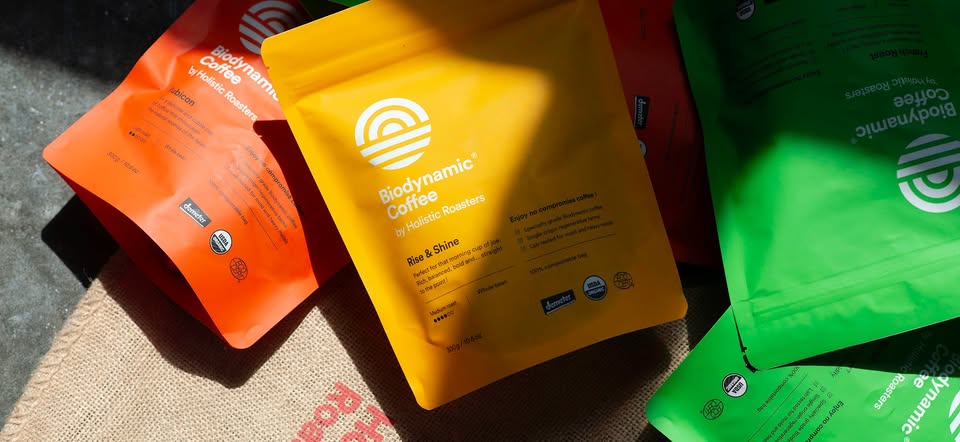
Every bag ships in 100% compostable packaging — the bag itself, the degassing valve that releases CO₂ after roasting, and the resealable zipper closure. No plastic component in the entire package. This matters not only for environmental reasons but for product purity — plastic packaging is a documented source of microplastic contamination in consumer food products, and eliminating it entirely is something very few food brands of any kind have managed to do.
Claims & Certifications
What Holistic Roasters Claims — And What Each One Actually Means
Independent Research & Lab Testing
What the Labs Found — Every Result, Disclosed in Full
Actlabs — 16-compound mycotoxin panel, every harvest: Actlabs Agriculture Division has tested every Holistic Roasters harvest for ochratoxin A, all four regulated aflatoxins (B1, B2, G1, G2), deoxynivalenol (DON), fumonisins B1 and B2, T-2 toxin, HT-2 toxin, zearalenone, mycophenolic acid, and additional compounds. On every harvest tested to date, ochratoxin A and all four regulated aflatoxins have been below the assay's detection limit — clean on the compounds that matter most, the ones classified as possible or known human carcinogens by the International Agency for Research on Cancer. All certificates are published at biodynamic.coffee/pages/lab-results.
One result Holistic Roasters chose to publish anyway: In December 2025, one harvest lot — Peru Biodynamic, sample D25-005852 — showed Mycophenolic Acid at 0.05 ppm. Mycophenolic Acid is a non-regulated compound not covered by FDA or EU coffee standards. At five cups of coffee per day, a person would consume approximately 3.5 micrograms — roughly one-millionth of the lowest medical therapeutic dose, which is 1–3 grams per day in clinical settings. This compound appears commonly in the environment and in many food products; its presence in this single lot does not represent a safety concern by any recognized standard. Holistic Roasters published the certificate of analysis anyway. Without alteration. That act of transparency — disclosing a clinically insignificant result they were under no obligation to share — is worth more to us, as evaluators, than a clean result with no disclosure mechanism.
Eurofins — heavy metals and microbiology, every harvest: Eurofins Essais Alimentaires has tested every harvest for lead, cadmium, mercury, and arsenic by ICP-MS, along with E. coli, Salmonella, and Listeria. On every harvest tested to date, all four heavy metals have been below the detection limit. No microbiological contamination has been identified. All certificates are published in full. The growing conditions — regenerative biodynamic soil without synthetic fertilizers, on single-estate farms with documented soil health programs — provide meaningful upstream protection against heavy metal uptake, since heavy metal bioavailability in crops is directly influenced by soil health, pH, and the absence of synthetic inputs that can mobilize soil metals.
"Most competitors claiming '100% mycotoxin-free across every harvest' achieve that claim by testing fewer compounds — not by having cleaner coffee. Holistic Roasters tests more compounds, publishes every result unedited, and discloses even the ones they were not required to share."
Source: Best Mold-Free Coffee Brands of 2026 — biodynamic.coffee. All primary lab certificates are published at biodynamic.coffee/pages/lab-results.
The Broader Picture
Why Most Coffee — Including Organic — Falls Short of This Standard
Mycotoxins in coffee are a real and documented problem. A 2024 systematic review published in the journal Food Additives and Contaminants analyzed over 3,250 coffee samples worldwide and found ochratoxin A present in approximately 55% of all samples tested. A separate 2024 meta-analysis published in Reviews on Environmental Health put the global prevalence of OTA in coffee at 58%. Ochratoxin A is classified as a Group 2B possible human carcinogen by the International Agency for Research on Cancer and is nephrotoxic — meaning it causes kidney damage with long-term exposure. It is heat-stable enough to survive the roasting process and research shows that 74 to 86 percent of the OTA present in roasted beans transfers directly into the brewed cup. This is not a fringe concern. It is a systemic quality issue in the global coffee supply, and most brands — including many that market themselves as clean or organic — do not test for it comprehensively.
Heavy metals in coffee are a growing area of independent scrutiny. The Clean Label Project's August 2025 study tested 57 coffee products from 45 top-selling brands across more than 7,000 individual tests and found heavy metals, pesticide residues, phthalates, and glyphosate breakdown products present across the category — including in certified organic coffees. The study noted that AMPA, a breakdown product of glyphosate, was detected in 100% of organic coffee samples tested — a finding that demonstrates how environmental contamination can reach certified organic crops through soil and water runoff regardless of farming practices. This is exactly why testing the finished product matters in addition to, not instead of, controlling the growing environment.
Most clean-coffee brands make claims they cannot fully prove. In our research across the entire coffee category, the dominant pattern was this: a brand claims third-party testing, extensive contaminant panels, and laboratory-verified purity — and then provides no publicly available documentation for any of it. Certificates of analysis described as available "upon request." Lab partners unnamed. Panel scopes undisclosed. Testing frequency unspecified. Some brands confirmed explicitly, when contacted by independent reviewers, that results are "considered proprietary." A testing claim with no verifiable evidence is not a safety guarantee. It is marketing language.
Holistic Roasters is the exception. Every claim is verifiable. Every result is published. The lab names, accreditation numbers, report IDs, sample IDs, and result values are all present on their website. A customer who wants to verify that their specific harvest lot was tested can find the certificate for that lot, confirm the laboratory accreditation independently, and read the actual numerical results from the analytical instrument. This level of documentation is rare in the coffee category. We have not found it anywhere else at this depth.
We chose to list Holistic Roasters anyway — before any financial relationship existed, and regardless of whether one ever forms — because this product earns the Bonham Gold Label on its own merits. The certification standards, the lab testing protocol, the publishing of every result unedited, the compostable packaging, and the proactive disclosure of even non-mandatory findings represent exactly the kind of integrity this brand was built to recognize and reward. If and when an affiliate relationship is established, we will update this disclosure accordingly. If it is never established, this product will remain on Bonham Brands because the right product for our customers is not the product that makes us the most money.